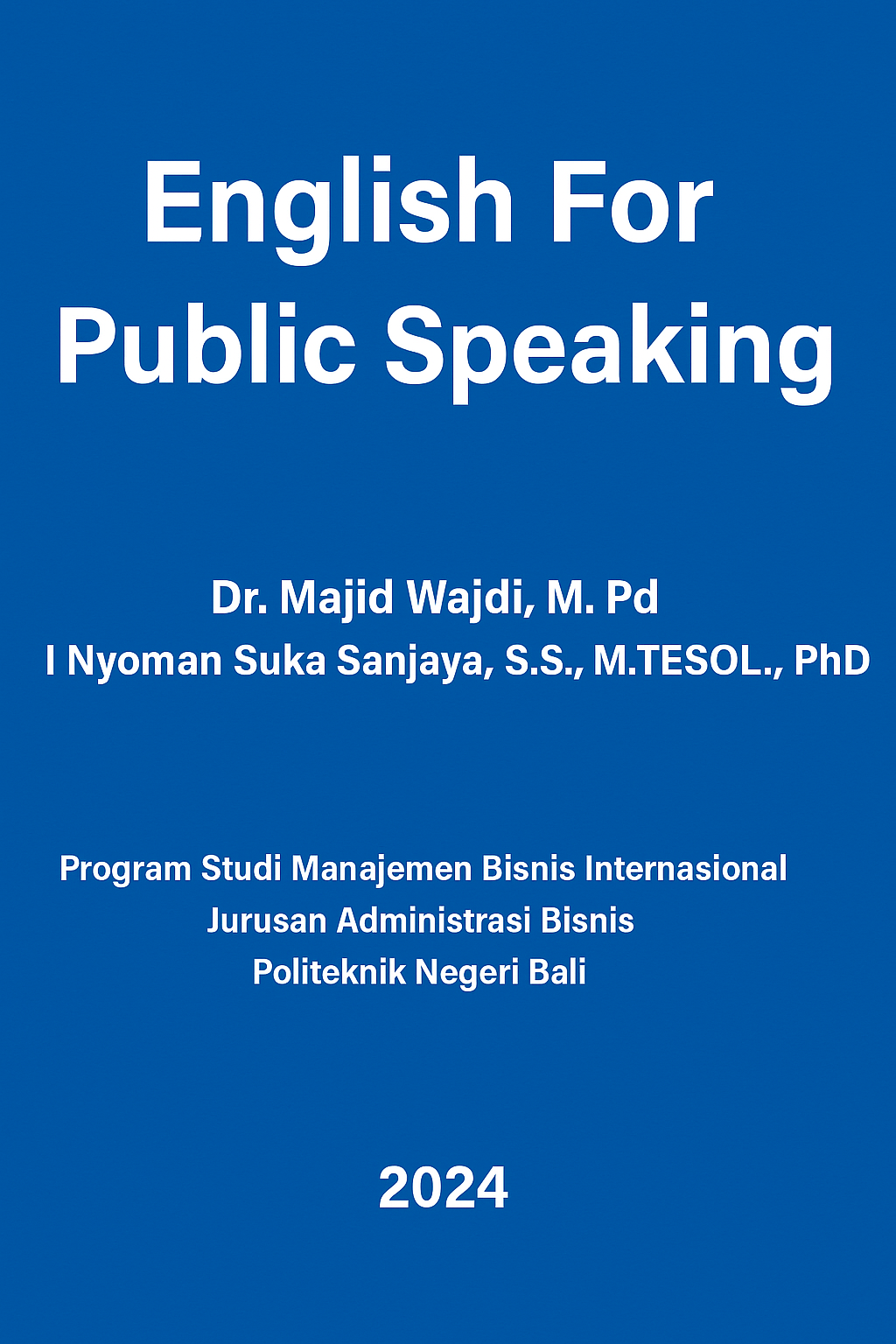
English For Public Speaking
Introduction to public speaking
DOI:
https://doi.org/10.71028/s9f2dn37Keywords:
public speaking, Communication Skills, Professional Development, Verbal and Non-verbal Communication, Academic PerformanceAbstract
Public speaking is one of the most valuable and empowering skills that students can develop during their university education. Whether presenting ideas in a classroom, delivering a pitch in a business meeting, or addressing a crowd in a community setting, the ability to speak confidently and clearly in front of others is essential. It not only enhances academic performance but also plays a crucial role in professional success and civic engagement. In today’s globalized and communication-driven world, strong public speaking skills set individuals apart and prepare them for leadership, collaboration, and effective information sharing.
At its core, public speaking is the act of delivering a structured message to an audience with the intention of informing, persuading, or entertaining. Unlike casual conversation, public speaking requires preparation, clarity, and the ability to engage listeners. It involves not only verbal communication but also non-verbal elements such as posture, gestures, eye contact, and tone of voice. When these elements are used effectively, they help reinforce the speaker’s message and build trust with the audience.
Understanding the importance of public speaking begins with recognizing the roles it plays in various aspects of life. In academic settings, students are often required to give presentations, defend projects, and participate in discussions, all of which demand public speaking skills. In the professional world, employers highly value individuals who can articulate ideas, lead meetings, and represent their organizations confidently. Even outside the workplace, public speaking is vital in community leadership, volunteer work, and personal development. The ability to speak well helps individuals advocate for causes, share knowledge, and inspire others.
There are several types of public speaking, each with a distinct purpose. The main types include informative, persuasive, demonstrative, ceremonial, and impromptu speaking. Informative speeches aim to educate the audience on a particular topic, often using facts and data. Persuasive speeches seek to influence opinions or encourage action. Demonstrative speeches explain how to perform a task or process. Ceremonial speeches are used in formal events, such as weddings, graduations, or award ceremonies. Impromptu speaking, on the other hand, requires the speaker to talk with little or no preparation, which challenges their ability to think and speak quickly.
By exploring these types early in the course, students can begin to identify their strengths and areas for improvement. They also start to see that public speaking is not a one-size-fits-all skill but a flexible tool that can be adapted to different situations and audiences.
In conclusion, this first topic—Introduction to Public Speaking—provides a vital foundation for understanding the value, purpose, and variations of speaking in public. It encourages students to reflect on their current speaking habits, gain awareness of effective communication techniques, and begin building the confidence they need to succeed. With the right mindset and practice, every student can become a powerful and persuasive speaker, capable of making a meaningful impact in any setting.
Downloads
References
Beebe, S. A., & Beebe, S. J. (2021). Public speaking handbook (6th ed.). Pearson.
Berkowitz, S., & Patalano, F. (2001). Public speaking anxiety as a function of trait anxiety and perceived instructor expectations. Communication Education, 50(4), 367–376. https://doi.org/10.1080/03634520109379256
Carnegie, D. (2005). The quick and easy way to effective speaking. Pocket Books. (Original work published 1962)
Harvard College Writing Center. (n.d.). Harvard speaking center. https://speakingcenter.fas.harvard.edu
LeFebvre, L. E., & Allen, M. (2014). Examining the relationship between public speaking anxiety and student achievement. Journal of Undergraduate Research, 7, 1–10.
Lucas, S. E. (2020). The art of public speaking (13th ed.). McGraw-Hill Education.
MacIntyre, P. D., & Thivierge, K. A. (1995). The effects of audience pleasantness, audience familiarity, and speaking context on public speaking anxiety and willingness to communicate. Communication Quarterly, 43(4), 456–466. https://doi.org/10.1080/01463379509369980
Morreale, S. P., & Pearson, J. C. (2008). Why communication education is important: The centrality of the discipline in the 21st century. Communication Education, 57(2), 224–240. https://doi.org/10.1080/03634520701861713
O’Hair, D., Rubenstein, H., & Stewart, R. (2020). A pocket guide to public speaking (6th ed.). Bedford/St. Martin’s.
Toastmasters International. (n.d.). Resources for speakers. https://www.toastmasters.org/resources
TED. (n.d.). TED speaker guide. https://www.ted.com/participate/organize-a-local-tedx-event/tedx-organizer-guide/speaker-guide
Wrench, J. S., Goding, A., Johnson, D. I., & Attias, B. A. (2011). Stand up, speak out: The practice and ethics of public speaking. Saylor Foundation. https://saylordotorg.github.io/text_stand-up-speak-out/
Zarefsky, D. (2016). Public speaking: Strategies for success (7th ed.). Pearson.
Downloads
Published
Issue
Section
License
Copyright (c) 2025 Majid Wajdi, I Nyoman Suka Sanjaya

This work is licensed under a Creative Commons Attribution-NonCommercial-ShareAlike 4.0 International License.
The Publisher operates under a Creative Commons Attribution 3.0 License, which allows for unrestricted use, distribution, and reproduction of its content, provided proper citation of the original work.