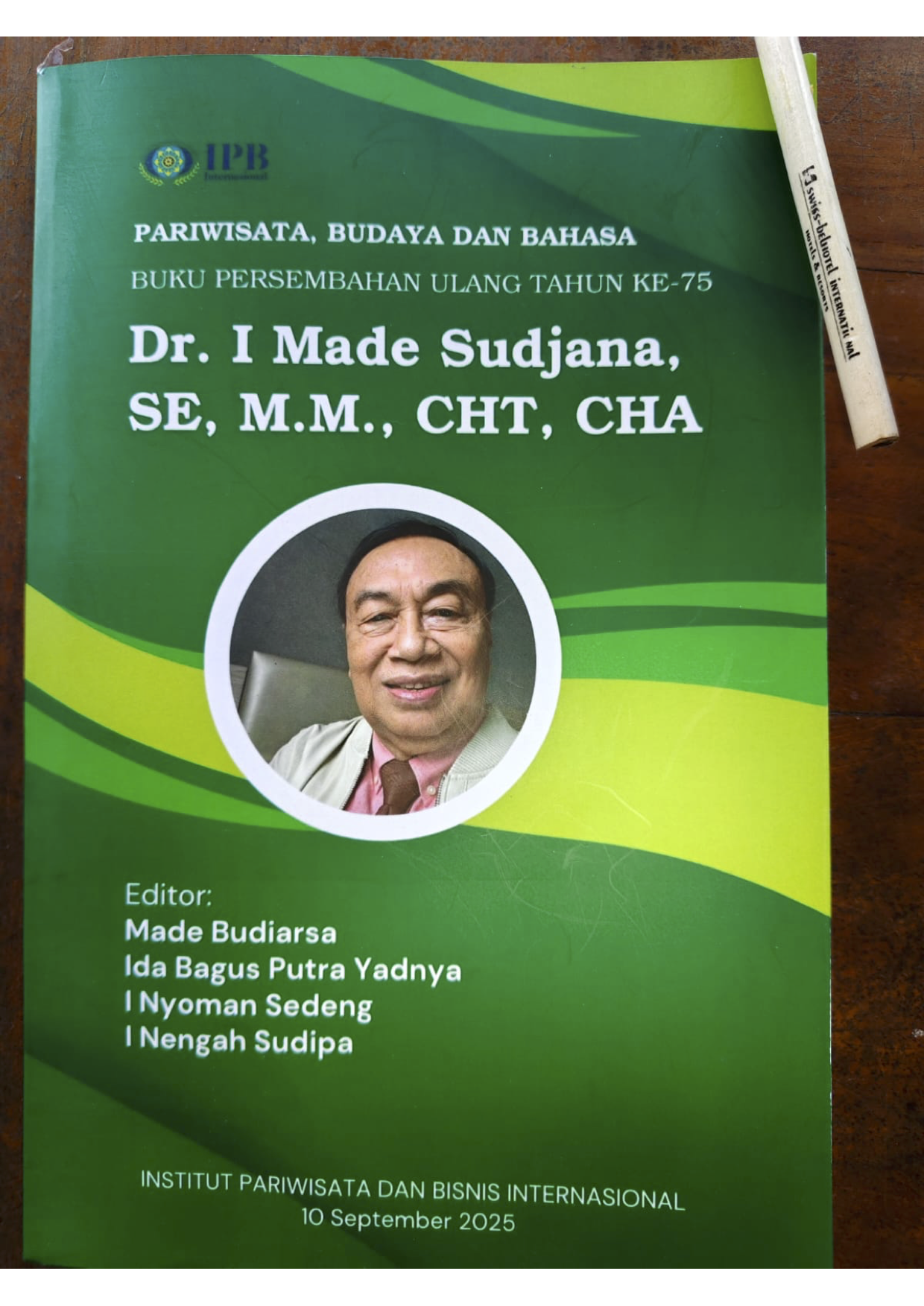
Sinergi Bahasa, Budaya dan Pariwisata dalam Penguatan Identitas Destinasi dan Pelestarian Warisan Lokal
DOI:
https://doi.org/10.71028/b7e8zk54Keywords:
komunikasi multi bahasa, identitas destinasi, narasi lokal, pelestarian budaya, pariwisata budayaAbstract
In the context of cultural tourism, language plays a vital role not only as a communication tool but also as a medium for conveying cultural values and meanings. This study aims to explore how language facilitates the transmission of local culture and how the synergy between language, culture, and tourism enhances destination identity and competitiveness. This study employs a descriptive qualitative method, combining literature review and document analysis. Data were drawn from tourism promotion materials, cultural narratives in brochures and digital media, as well as cultural tourism policy documents. The results indicate that integrating local language and contextual cultural narratives strengthens tourist experiences and promotes cross-cultural understanding. Furthermore, involving local communities and enhancing multilingual communication improve the educational and authentic value of destinations. Language and culture should be considered strategic components in sustainable tourism promotion. Cross-sector collaboration, intercultural communication training, and inclusive tourism storytelling are essential for preserving cultural heritage while enhancing tourism competitiveness.
Downloads
References
Byram, M. (1997). Teaching and assessing intercultural communicative competence. Multilingual Matters.
Chronis, A. (2012). Between place and story: Gettysburg as a performance of American civil religion. Journal of Consumer Culture, 12(3), 295–312. https://doi.org/10.1177/1469540512446874
Cohen, E., & Cooper, R. (1986). Language and tourism. Annals of Tourism Research, 13(4), 533–563. https://doi.org/10.1016/0160-7383(86)90020-3
Hall, C. M. (1997). Geography, marketing and cultural tourism. Journal of Travel and Tourism Marketing, 6(3–4), 61–84. https://doi.org/10.1300/J073v06n03_04
Hughes, G. (2016). Authenticity in tourism. Tourism Management, 17(1), 783–793. https://doi.org/10.1016/j.tourman.2015.10.023
Kim, Y. Y. (2001). Becoming intercultural: An integrative theory of communication and cross-cultural adaptation. SAGE Publications.
Kramsch, C. (1998). Language and culture. Oxford University Press.
Ministry of Tourism and Creative Economy. (2020). Tourism statistics report 2019. Kemenparekraf RI.
Nugroho, I. (2020). Pariwisata budaya dan komunikasi multibahasa: Tantangan dan peluang. Jurnal Ilmu Komunikasi, 18(2), 115–130.
Picard, M. (1996). Bali: Cultural tourism and touristic culture. Archipelago Press.
Richards, G. (2018). Cultural tourism: A review of recent research and trends. Journal of Hospitality and Tourism Management, 36, 12–21. https://doi.org/10.1016/j.jhtm.2018.03.004
Salazar, N. B. (2012). Community-based cultural tourism: Issues, threats and opportunities. Journal of Sustainable Tourism, 20(1), 9–22. https://doi.org/10.1080/09669582.2011.596279
Smith, M., & Robinson, M. (2006). Cultural tourism in a changing world: Politics, participation and (re)presentation. Channel View Publications.
Timothy, D. J., & Boyd, S. W. (2003). Heritage tourism. Pearson Education.
UNESCO. (2003). Convention for the safeguarding of the intangible cultural heritage. https://ich.unesco.org
UNWTO. (2019). Tourism and culture synergies. World Tourism Organization. https://www.unwto.org
White, H. V. (2013). The content of the form: Narrative discourse and historical representation. Johns Hopkins University Press.
Yamashita, S. (2003). Bali and beyond: Explorations in the anthropology of tourism. New York: Berghahn Books.
Downloads
Published
Issue
Section
License
Copyright (c) 2025 Majid Wajdi (Author)

This work is licensed under a Creative Commons Attribution-NonCommercial-ShareAlike 4.0 International License.
The Publisher operates under a Creative Commons Attribution 3.0 License, which allows for unrestricted use, distribution, and reproduction of its content, provided proper citation of the original work.